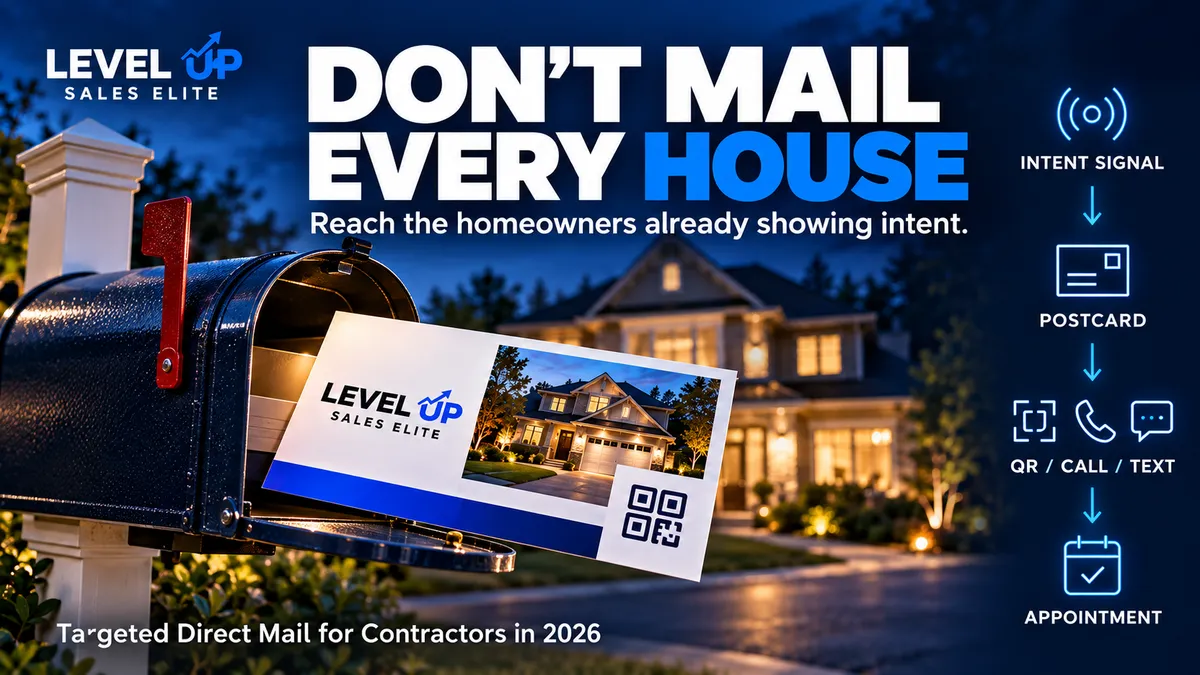
Targeted Direct Mail for Contractors in 2026: Why Intent Beats Saturation
Direct mail never really disappeared from home-service marketing. Roofers use it. Window companies use it. HVAC companies use it. Remodelers use it. Landscapers use it.
And contractors still invest in putting postcards into homeowners’ mailboxes.
The problem is not direct mail itself. The problem is how a campaign decides who receives it.
A traditional campaign often begins with a ZIP code or neighborhood. Then every house gets the same postcard.
Some homeowners may actually need the service. Others may not. That means part of the budget is spent hoping the right homeowner happens to see the right message at the right moment.
In 2026, contractors can approach direct mail differently.
Instead of asking: “Which neighborhood should we mail?”
Ask: “Which homeowners are showing signals that this service may already be relevant to them?”
That shift turns direct mail from a broad awareness tactic into something much closer to a targeted customer-acquisition channel.
Direct Mail Is Getting More Expensive — Which Makes Targeting More Important
USPS updated mailing-service pricing effective July 12, 2026, including USPS Marketing Mail pricing.
For contractors, the lesson is simple. When every mailed piece has a real printing and postage cost, sending fewer pieces to a more relevant audience becomes increasingly attractive.
A contractor does not necessarily need to mail 10,000 households if only a small portion of those households have any current reason to consider the service.
The goal should not be: Send the most postcards.
The goal should be: Create the most qualified conversations per dollar spent.
That distinction changes everything.
Saturation Mail and Targeted Mail Solve Different Problems
Saturation mail is useful when your goal is broad neighborhood visibility.
Maybe you just completed a roofing project and want surrounding homeowners to see your company. Maybe you are entering a new service area. Maybe your objective is simply brand recognition.
There is nothing inherently wrong with that.
But saturation mail has one major limitation: You are targeting geography, not buying intent.
A homeowner may have:
a brand-new roof
new windows
a recently replaced HVAC system
no interest in remodeling
no intention of spending money on the service you are promoting
They receive the postcard anyway.
Targeted direct mail starts from a different premise. Instead of beginning with the mailbox, it begins with the prospect.
What Is High-Intent Direct Mail?
High-intent direct mail combines audience data with physical outreach. The idea is to identify homeowners who are more likely than the general population to be interested in a specific product or service, then send messaging that matches that interest.
That does not mean intent data guarantees someone will buy. Intent is a signal, not a sale.
But it can give contractors another layer of relevance beyond simply knowing where somebody lives.
For example, if a homeowner is showing interest around replacement windows, the outreach should not say: “We Do Home Improvements.”
It should address the problem that may already be on that homeowner’s mind.
Fogging glass.
Drafts.
Hard-to-open windows.
High energy bills.
Aging frames.
Water intrusion.
Noise.
The more closely the message matches the underlying problem, the less the postcard feels like random advertising.
Intent Signal → Matching Problem → Matching Offer
This is where contractor direct mail gets interesting. Imagine two postcards.
The first says: ABC Home Improvement — Call Us for Your Next Project!
The second says: Are Your Windows Drafty, Fogging or Getting Harder to Open?
Both reach the same homeowner. But one asks the homeowner to figure out why the company matters. The other immediately connects to a possible problem.
That is the basic psychology behind intent-relevant outreach.
The prospect should quickly recognize: “This might actually be for me.”
That moment matters far more than adding another logo, badge or paragraph to the postcard.
The Postcard Should Not Try to Close the Sale
This is another place contractor campaigns often go wrong. A postcard does not need to explain your entire company. It does not need to list eighteen product features. It does not need to overcome every objection.
It has one primary job: Earn the next action.
That action might be:
scan a QR code
visit a landing page
text a keyword
call a number
request an inspection
schedule an appointment
The postcard opens the conversation. Your acquisition system continues it.
Why QR Codes Matter More When the Landing Page Matches
Putting a QR code on a postcard is easy. Creating a meaningful response path is harder.
If the postcard discusses drafty windows and the QR code lands on a generic homepage that says: “Welcome to ABC Remodeling!” you have broken the continuity of the message.
A stronger path looks like: Intent signal → problem-specific postcard → matching landing page → simple CTA
For example: Window-draft message → Window Performance Check page → Request a free inspection
That creates continuity. The homeowner sees the same problem and same offer throughout the journey. They do not have to figure out what to do next.
Track Every Response Path
Direct mail becomes much more valuable when it stops being a marketing mystery. Contractors should be able to identify responses generated by the campaign.
That can include:
QR scans
landing-page visits
form submissions
calls
texts
appointments
sales
revenue
USPS highlights QR codes, dedicated URLs and campaign-specific phone numbers as ways to measure direct-mail response instead of relying only on “How did you hear about us?”
This is especially important when testing multiple messages. If one postcard focuses on drafts and another focuses on fogging glass, you want to know which one actually creates conversations.
Without tracking, you are guessing.
List Quality Matters More Than Pretty Design
Great design helps. But the best-looking postcard in the world cannot fix the wrong audience.
Direct-mail performance can vary based on list quality and audience fit. USPS recommends checking a purchased list’s source, update history and accuracy before mailing.
That makes intuitive sense. Consider three homeowners.
Homeowner A has no need for your service.
Homeowner B may need it someday.
Homeowner C is actively researching the problem right now.
Which one would you rather spend money reaching? The answer is obvious.
This is why audience selection deserves at least as much attention as the postcard itself.
A Prospect Is Not Yet a Lead
There is also an important distinction contractors should understand. Someone identified through an intent signal is a prospect. They become a lead when they respond or otherwise engage in a way that creates a real sales opportunity.
That distinction keeps the economics honest.
High-intent prospecting is designed to improve who you approach.
The outreach’s job is to earn attention.
The landing page’s job is to earn a response.
The follow-up’s job is to earn a conversation.
The salesperson’s job is to earn the sale.
Those are different stages. A good customer-acquisition system connects all of them.
Physical Mail and Digital Follow-Up Work Better Together
Direct mail should not operate as an isolated campaign. Think of it as the physical front end of a digital acquisition system.
A homeowner receives the postcard. They scan the QR code. They reach the landing page. They submit their information.
With the right setup and appropriate permissions, the system can respond immediately.
That might trigger:
an acknowledgment text
an email
an AI conversation
an appointment link
a salesperson notification
a follow-up sequence
LevelUp’s high-intent system is designed around that type of flow: identify local homeowner intent, send intent-relevant physical outreach where applicable, capture responses through QR/form/call/text, manage the opportunity, and continue follow-up through the sales cycle.
That is fundamentally different from mailing a postcard and hoping the phone rings.
Speed Still Matters After the Scan
Targeting does not rescue poor follow-up.
Imagine spending money to identify the right homeowner. Then paying to print the postcard. Then paying to deliver it.
The homeowner scans the QR code. They submit a request. And nobody responds until tomorrow.
You did the difficult part correctly and still risk losing the opportunity.
The acquisition system must continue after the response.
LevelUp’s CRM and automation platform supports AI conversations, SMS, appointment booking, follow-up workflows and pipeline management for precisely this reason. Advanced AI communication is optional and depends on the selected setup.
The CRM is not the lead-generation strategy. It is the infrastructure that helps prevent the lead-generation investment from being wasted.
Use the Homeowner’s Problem as the Creative
One of the simplest ways to improve contractor direct mail is to stop leading with the contractor.
Homeowners do not wake up excited to research contracting companies. They wake up frustrated because:
the roof is leaking
the room is cold
the patio door is drafty
the AC is struggling
the siding looks terrible
the bathroom no longer works for their family
Start there. Problem-awareness messaging can earn attention because it reflects what the homeowner is already experiencing.
For a window campaign: Do Your Windows Look Fine — But Feel Cold Every Winter?
For roofing: One Small Roof Leak Can Become a Much Bigger Repair.
For HVAC: Is One Room Always Too Hot or Too Cold?
For remodeling: Has Your Home Stopped Working for the Way Your Family Lives?
The homeowner’s problem is the hook. Your company is the solution.
Give Them a Low-Friction Offer
The next step should feel easy. Contractors frequently ask prospects to make too large a commitment too early. “Schedule Your $30,000 Window Project.”
That is not how homeowners think. A lower-friction offer gives them a reason to begin the conversation without feeling trapped.
Examples include:
free inspection
performance check
same-day quote
project consultation
roof assessment
energy-efficiency review
design consultation
The offer should match the problem and the stage of awareness. The postcard does not need to create the sale. It needs to create the next conversation.
Test Problems, Not Just Headlines
Contractors often A/B test:
red button versus blue button
big logo versus small logo
photo A versus photo B
Those tests can matter. But much larger gains may come from testing the underlying problem.
For example:
Campaign A: Stop Drafty Windows
Campaign B: Tired of Fogging Glass?
Campaign C: Windows Hard to Open?
Campaign D: Concerned About High Energy Bills?
Those are different motivations. Tracking QR scans, inquiries, appointments and sales by campaign can reveal which homeowner problem produces the strongest business outcome. Now direct mail becomes market research.
Build a Feedback Loop
The strongest acquisition systems improve over time. Suppose you send several small campaigns. You learn that:
one ZIP code responds better
one homeowner profile produces larger projects
one keyword signal converts better
one postcard problem generates more scans
one landing page creates more appointments
Use that information. Send less mail to poor-performing segments. Send more to stronger segments.
Refine the offer. Refine the message. Refine the geography.
That is how targeted direct mail becomes a system instead of an event.
Direct Mail Should Be Measured by Sales, Not Postcards
A cheap postcard is not automatically good marketing. Neither is a high response rate.
Ultimately, measure: Cost per prospect → response rate → cost per lead → appointment rate → completed appointment rate → close rate → revenue
That is the same discipline you should apply to Google Ads, Facebook, SEO or any other lead source.
The channel is different. The business math is the same.
The Future of Contractor Direct Mail Is More Targeted, Not More Generic
Direct mail still has a place in contractor customer acquisition. But the strongest opportunity in 2026 is not simply sending more pieces. It is making each piece more relevant.
Start with the right audience.
Use a problem they recognize.
Match the message to the intent.
Give them an easy next step.
Track the response.
Follow up immediately.
Continue nurturing if they are not ready today.
That turns a postcard into part of a complete acquisition system.
And that is the bigger idea behind LevelUp: Find better opportunities. Give those opportunities a reason to respond. Then build a system that keeps working them until the timing is right.
Ready to Stop Mailing Blind?
LevelUp Sales Elite helps contractors and high-ticket sales professionals build customer-acquisition systems around high-intent prospecting, intent-relevant outreach, digital response paths, automated follow-up, appointment booking, and Did Not Sell (DNS) recovery.
Explore LevelUp’s High-Intent Sales Rep System to see how intent signals and physical outreach work together.
Explore Lead Generation for broader customer-acquisition solutions.
Then see how AI & CRM Automation helps keep those opportunities moving once someone responds.
Book a free strategy call and let’s look at how targeted your current lead-generation system really is.
Frequently Asked Questions
Is direct mail still effective for contractors in 2026?
It can be, particularly when audience targeting, message relevance, tracking and follow-up are handled well. Actual performance varies substantially by list quality, offer, market and campaign execution.
What is targeted direct mail?
Targeted direct mail sends physical marketing to selected households or prospects based on defined criteria rather than mailing every address in a geographic route. Criteria can include geography, property characteristics, customer history or other relevant audience signals.
What is high-intent direct mail?
High-intent direct mail uses signals suggesting that a product or service may currently be relevant to a prospect, then matches the physical outreach to that interest. An intent signal should be treated as an indicator of possible interest, not a guarantee that someone will buy.
Should contractors use postcards or digital advertising?
They can work together. Digital advertising can generate immediate demand, while targeted physical mail can reach selected households outside crowded digital feeds. The strongest strategy depends on customer value, geography, urgency, cost and the contractor’s ability to track actual sales.
How should contractors track postcard leads?
Use campaign-specific QR codes, landing pages, forms, tracking numbers or text keywords, then track the resulting leads through appointments and sales. This allows the campaign to be measured on revenue rather than simply the number of pieces mailed.
